The humble @

I am currently reading David Crystal’s “”A Little Book of Language”. Crystal has written an expert guide to language and linguistics. 
I am currently reading about the effect of modern technology on language. For example, let’s look at the “@” symbol. 
In the 1970s when Ray Tomlinson sent the very first email he inserted the “@” sign into email addresses. 
Today it not only appears in email addresses but it is also a handle for certain social media. 
In English we refer to it as the “at” symbol. But the same symbol has attracted different interest and descriptions in other countries. 
For example, in Denmark it is thought the “@” resembles an elephant’s truck and that is how they refer to it. 
In German, it is thought to resemble a monkey’s tail and that is how they describe it or little monkey. 
In Greek, it is called “papaki” or little duck.
In Hebrew, it is called a strudel. 
The Italians call it “chiocciola” meaning snail. 
The Chinese believe it looks like a mouse. 
In Finland, it is either “miukumauka” meaning miaow or “kissanhnta” meaning cat’s tail. 
In Korea, it is called “golbangi” meaning sea snail. 
In Russia, it is said to resemble a dog or dog face.
English can be so unimaginative. 

Onions and the wonderful world of umami 

(Pollan on cooking) “But even better, I found, is the satisfaction of temporarily breaking free of one’s accustomed role of producing the one thing – whatever it is you sell into the market – and being the passive consumer of everything else.”

I have just finished reading Michael Pollan’s “Cooked” and am excited by what it has taught me about the ancient art of cooking. The theme of the book is that cooking involves the transformation of meat and plant matter, and the four transformations coincide with the traditional elements namely earth, wind, fire, and water.
The subtitle of the book is “”A Natural History of Transformation”. In the section dealing with fire, Pollan explores traditional whole animal barbecue as practised by the pitmasters from the Southern states of the USA. In exploring transformation by water he explores the world of stews and braises. In the section dealing with air, he looks at  bread baking, because after all, isn’t a loaf of bread but trapped air. Finally, in the earth section he takes us through a fascinating journey through the world of food fermentation. 
Michael Pollan is an acclaimed US journalist, who was recently included in “Times” 100 most influential people in the world. His books always appear in the New York Times bestseller list and “Cooked” is no exception. 
I have never read a cook book or a book on cooking, but I could not put down Pollan’s book. Over the next few weeks I hope to share some of the insights I gained from the book in the hope that it will spark your interest in this activity which is increasingly being seen as mundane and boring. 
I recommend “Cooked” to anyone interested in a fascinating and insightful read.
Let us begin our review of “Cooked” with a look at the humble but ubiquitous onion. Ever asked yourself 
“”Why do I always find myself chopping up onions?”
Rest assured you are not alone. Onions represent the “starter” for meals all over the world.  
If you begin your pot dish by sautéing chopped onions, carrots and celery in butter or sometimes olive oil you’ve made a “mirepoix”, which marks your dish as French. 
If you begin with a mince of onions, carrots and celery sautéed in olive oil (and perhaps add some garlic, fennel or parsley) then you’re beginning an Italian dish with a “soffritto”, (in Italian soffritto means underfried).
But soffritto with one “f” and “t” – “sofrito”is Spanish and normally includes onions, garlic and tomato in place of celery. Cajun cooking begins with onions, garlic and bell peppers.
If you begin with diced spring onions, garlic, and ginger you are moving towards Eastern cuisine, as this is an “Asian mirepoix”.
In India a “tarka” comprises diced onions and spices sautéed in clarified butter or ghee.
Returning to our question about why we spend so much time chopping onions. Scientific research has revealed that low, slow heating of vegetables, breaks down the long chains of proteins into their constituent amino acids, some of which like glutamic acid are known to give foods a meaty savoury taste called – “umami”.
We were all taught that we can perceive four tastes namely salty, sweet, bitter and sour. Now we know there is a fifth taste – umami and like each of the others there are receptors on our tongue dedicated to detecting its presence. 
Named after “umai” which is Japanese for “delicious”, umami was recognised as a fully fledged taste by the Japanese in 1908. It was discovered by a chemist named Kikunae Ikeda who was investigating the flavours emitted by dried Korbut, a seaweed used as stock in a number of Japanese dishes. 
Umami was not recognised as a separate taste in the West until 2001 when scientists discovered the separate receptors on the tongue that detected umami.

More to follow ……

First class justice from a second world country


Picture courtesy of bbc.com
As a lawyer and person concerned with social justice and the rule of law I have watched with a mixture of interest and dread the recent machinations both here and abroad over Australia’s overseas detention camps. 
These camps were originally established as offshore processing centres, to manage the influx of asylum seekers bound for Australia. In reality, very little processing is done at these camps. Virtually no resettling of refugees occurs in the host country or any other country. They have become detention centres where refugees are kept for indefinite periods of time.
These camps predominantly on Manus Island and Nauru are operated by Australian contractors, such as Transfield. The contractors and the host countries are paid $millions by the Australian government to keep the camps operational and to keep the refugees away from our shores. 
In recent times the highest courts in two countries have ruled on the legality of these camps. The Australian High Court ruled that Australia’s detention camps in Nauru and the agreements between the Australian and Nauruan governments to establish and operate these camps are valid and supported by the Australian Constitution. 
On the other hand, the Supreme Court of Papua New Guinea (PNG), has held that the Australian government’s camp on Manus Island was not supported by the PNG constitution and therefore needs to be closed. 
How two different nations could arrive at opposite conclusions on the same issue is instructive. 
The Australian decision concerned a Bangladeshi woman known as plaintiff M68 who had been brought to Australia from Nauru for medical treatment late in her pregnancy. Her child was born here. She had a baby daughter. She effectively represented 37 babies born in Australia but condemned to indefinite detention in the squalid conditions on Nauru (and Manus Island).
The case brought by the Human Rights Law Centre challenged the validity of the commercial arrangements that established and operated these camps and the constitutional support, if any, for these arrangements. 
Even though the proceeding had been on foot for several months, in mid 2015 there was a sense of panic in the government’s ranks, when it became apparent that their defence of this challenge was not certain. Under the law as it stood, the Australian government stood to lose this case and throw into doubt their multi-billion dollar arrangements in Nauru and possibly PNG. 
The solution was to pass wide-sweeping retrospective legislation to ensure the government’s tracks were covered, back to 2012.
So it came to pass, that on a cold wintry day in June 2015, the Abbott government introduced and passed an amendment to the Migration Act. The date, 25 June 2015, will go down in history as the infamous night that s198AHA became law. I say “night” because despite Parliament’s busy schedule (what ever happened to legislation enshrining equal marriage rights for all citizens??) s.198AHA passed both Houses of Parliament in under 24 hours. The amendment was passed with bipartisan support, just 4 months before the case was to be argued before the High Court. 
The unsettling aspect of this manoeuvring by the government was the sheer breadth of this amendment. What does section 198AHA say?
“(1)This section applies if the Commonwealth enters into an arrangement with a person or body in relation to the regional processing functions of a country.

(2)The Commonwealth may do all or any of the following:

(a)take, or cause to be taken, any action in relation to the arrangement or the regional processing functions of the country;

(b)make payments, or cause payments to be made, in relation to the arrangement or the regional processing functions of the country;

(c)do anything else that is incidental or conducive to the taking of such action or the making of such payments.

(3)To avoid doubt, subsection (2) is intended to ensure that the Commonwealth has capacity and authority to take action, without otherwise affecting the lawfulness of that action.

(4)Nothing in this section limits the executive power of the Commonwealth.

(5)In this section:

action includes:

(a)exercising restraint over the liberty of a person; and

(b)action in a regional processing country or another country.

arrangement includes an arrangement, agreement, understanding, promise or undertaking, whether or not it is legally binding.

regional processing functions includes the implementation of any law or policy, or the taking of any action, by a country in connection with the role of the country as a regional processing country, whether the implementation or the taking of action occurs in that country or another country.” (my emphasis)
I despair when I read such unfettered expansion of government control over individuals. Read it carefully. The government can take any action or do anything it pleases, in respect to its detention camps either here or overseas even if such action deprives a person of their liberty; open-ended without any restrictions or oversight and retrospective. 
In February, this year the High Court in a 6-1 decision held that the government’s detention camps on Nauru were valid and legitimate by reason of s.198AHA and always have been since 2012. Further, s.198AHA was valid under the Australian Constitution. 
The High Court ruled that once asylum seekers are relocated in another country they were out of reach of Australian law. Only Justice Gordon in her dissenting judgment, was prepared to acknowledge Australia’s control over these operations, the funding of these camps with Australian dollars and the extensive control over the Nauruan government exercised by our government. 
The following day, Daniel Webb from HRLC had the unenviable task of telling mother M68 that she and her daughter, now a year old, had to return to an uncertain future on Nauru. 
But the Turnbull government’s euphoria was only to last a couple of months because across the waters to our north an important case was working its way through the justice system in PNG. Sometimes forgotten, the case commenced in 2013 by PNG’s opposition leader Belden Norman Namah, sought to challenge the constitutional validity of Australia’s detention camps on Manus Island. 
The camps that were reopened to human traffic in 2012, ostensibly to process asylum seekers, saw virtually little, if any, processing activities and became inhumane camps of indefinite detention. Namah was concerned at the violence shown towards detainees, the levels of self-harm and suicidal ideation expressed by refugees. There was not one but two cases of self immolation, detainees setting themselves on fire. 
The PNG’s defence of this challenge was funded by the Australian government. 
As happened in Australia, and no doubt, on advice from the Australian government, the PNG government also passed (last minute) legislation to improve its position in the challenge before the Supreme Court. 
The PNG constitution is of more recent origin than the Australian constitution. It is a modern document a creation of the the 20th Century rather than the 19th Century. 
Unlike the Australian constitution the PNG constitution contains a charter of human rights. Section 42 of the PNG constitution provides that no person may be deprived of his personal liberty. Pretty simple if not elegant. 
Despite the machinations of the PNG government to maintain the Australian camps, in what was a courageous decision (given the $millions injected into the PNG economy through these camps), the Supreme Court unanimously held that the camps were unconstitutional and should be closed. 
Two countries, same issue, different results. All plaudits to the PNG Supreme Court. PNG can hold its head high in international human rights circles. 
Australian law remains the law and must be respected. But the process followed by our politicians, the breadth of the relevant amendment, its deliberate attack on human rights ie “”exercising restraint over a person’s liberty”, its retrospective nature should provide cause for pause. 
Where will such flagrant disregard for basic human rights end? In the back of our minds, we say “But it will never affect me?” Are you sure? 
How is it that we are subject to a law that in most common law jurisdictions would be viewed as offensive and excessive legislation. 
Isn’t it strange that PNG should be handing Australia a lesson in human rights and social justice?

Anzac Day


Unfortunately I haven’t had time to pen a blog on ANZAC Day this year. My aim is to write about how Sir John Monash won the First World War for the allies. 

Instead, I reproduce my article from last year, the 100th anniversary of the Gallipoli landings. 


For the last ten years I have written an editorial on ANZAC day (and sometimes on Remembrance Day). Just a small piece seeking to make these days/events relevant to a modern (young) audience.


If you don’t like reading editorials or opinion pieces turn off or delete now.


Gallipoli was perhaps the first time that Australians did anything as Australians on the world stage. A debut. The nation was relatively new. Our population was a little under 5 million. The Federal Parliament still sat in Melbourne.


It turned into a tragic debut.


On 25 April 1915, 12,500 to 16,000 Australian troops landed at Gallipoli. In the days that followed, 860 Australians lost their lives and about 2000 were wounded. Ultimately, 8,709 Australian lives were lost during the Gallipoli campaign. A staggering 61,522 Australians died in the First World war.


This ANZAC Day I believe we should reflect on the unique character of the Australian soldiers. While Australians fought for the King and British Empire they were not British. They had grown apart from the traditions of Europe. They had established their own nation based on the democratic principles of universal suffrage for men and women. This and other concepts were foreign to the British and other Europeans and set the Australians apart. We should look at the early formation of the Australian identity.


I have identified 5 characteristics. Different people will produce different lists but here is mine.


1. Mateship

2. Affinity with New Zealand

3. Innovation

4. Humour

5. Inclusion


The first characteristic is mateship. I know the term is well worn and unfortunately become hackneyed. However, there is no other description for the strong bond that was forged between the Australian soldiers. It was a bond that saw them fight courageously in hopeless situations. It was a bond that saw them die for each other.  


These soldiers were volunteers. They were young men and women, a number in their teens. They fought in difficult conditions against a determined foe seeking to protect their homeland. The carnage was palpable. The experience of war was mind numbing.


They were far from home chasing an adventure that had turned into a nightmare. Their cause was ambiguous. What did the British want with Turkey, anyway? Australians from different States and different backgrounds became mates. They depended on each other. In these conditions, close and permanent bonds were formed.


The depth of feeling between the men could be seen in how they responded to the (surprise) decision to withdraw. The Australian reaction is recorded as unique and different from that of soldiers from other nations. Some Australians made crude wreaths for their fallen friends. Others attended their grave sites and straightened their crosses. A sense of guilt gripped many soldiers as they were leaving before any military objective was achieved. Some questioned what purpose was achieved by the death of their mates. Some carried this guilt into their twilight years.


This mateship or bond made the Australian units quite formidable in battle. There were many attempts to split the Australians so that each Allied division contained Australian soldiers. They were viewed as tenacious and courageous fighters. It was hoped that their attitude would infect the troops from other nations. But it was Australians fighting with Australians that promoted this bond. Dividing the soldiers would have broken this spirit.

Has this mateship survived a century of change? Do we care for our neighbour? How far will we extend ourselves for the sake of others?


The second feature is the affinity between the Australian and New Zealand soldiers. Australians should never forget that our New Zealand friends form the other half of the ANZAC equation. Australians and New Zealanders alike distinguished themselves at Gallipoli. While many Australians were honoured, the highest award was bestowed on New Zealand’s Major General Russell who was knighted. Some 2,700 New Zealanders were killed in the Gallipoli campaign.


Not many people know that in the 1890s, New Zealand was invited to join the new Australian federation. New Zealand representatives attended the first two federation conferences. However, New Zealand politely declined the invitation. The Australian Constitution still contains references to New Zealand.


In the ANZAC spirit, isn’t it time the two countries reviewed their respective positions on consolidation/merger? Isn’t the future, shaped by grand schemes and big ideas? How grand would it be for these two countries to come together? Over the last weekend, one commentator was speculating on what would happen to the world economy if the 12th largest economy joined with the 54th largest (and fast growing) economy? 30 million people, two locations, one country.


The third feature is innovation. The Allied forces at Gallipoli were at a distinct disadvantage.


Faced with these difficulties, they had to think quickly and innovatively.


The Australians were responsible for self-firing rifles that created the impression that the Allied soldiers were still in occupation, when in fact, they were in retreat from Gallipoli. These rifles were connected to empty buckets that filled slowly with dripping water. When the water reached a certain level the rifles would fire. And the process would then start again.


Grenades were made from empty tin cans.


On the European continent, Monash became famous for his innovative strategies. He pioneered the quick assaults on enemy positions by a small group of soldiers. These soldiers carried no equipment and moved quickly. Their lightning fast forays caused confusion in enemy ranks. Their small victories reduced German morale.


Monash used (harmless) smoke bombs to create the impression that the Allies were launching gas attacks. The Germans resorted to their gas masks which reduced their vision and made them vulnerable to attack from their flanks by Allied forces not wearing masks.  


Monash was among the first to see the benefits of tanks in any land engagement. Even though the first tank models were abject failures, Monash pressed his views until later models began realising the potential he had predicted.  


Even today Australian innovation regularly places us on the world stage. Unfortunately, too often, Australian ideas are not developed here. Foreign investors have the vision and capital that we lack.


The next feature is humour. In the face of adversity, Australians will always find some humour and wit. Despite the trying circumstances Gallipoli was no exception.  

For example, the beach at Anzac Cove was dubbed Brighton Beach. Australians produced plays and sketches to boost their morale. There was often a joke at the expense of an officer


Humour was evident among the ANZACS in the Second World War. I’ve just finished reading a history of the Outram Road Prison, Singapore. During World War II, Outram Road was a high security (generally) solitary confinement prison that Changi prisoners were sent to if they “misbehaved”. Many reported that Outram Road made Changi look tame. Few Australian prisoners survived their stint at Outram Road.  


At Outram Road, Australian prisoners had nicknames for the prison officers. One was called “Prune Face” not because of his wrinkles but because “he gave you the shits”.


One (brave) prisoner once interrupted the beating of his mate, (and probably saved his mate’s life as a result). For his courage he was flayed (with a whip and the flat of a sword) to within an inch of his life. After a few hours, of “punishment” he was returned to his cell and greeted by a new cell mate who was shocked and appalled at his bloody condition. Despite the torture he had just experienced, the prisoner turned to his new cell mate and said (with a smile) “Welcome to the luxury suite at Outram Road…”


Some Australian humour was directed at authority. A cynical view of our leaders and politicians remains a strong trait in the Australian make up.


Finally, the Australian contingent at Gallipoli were set apart by their sense of inclusion and equality. Despite a national White Australia policy, the Australian Army at Gallipoli comprised soldiers from a number of different countries, as well as indigenous men. No better example of inclusion was Monash himself. He was an outsider on many levels. Monash was a German with Jewish heritage. He was also a reservist. He had not served in the regular army until Gallipoli, at age 50.


Monash would never have reached the heights he did but for the culture of inclusion in the Australian Army. By contrast, the British Army was structured along class lines. This cultural divide created a number of issues. In preparation for the war on the Western Front, Monash sought to promote a regular to an officer’s rank. The British protested. They maintained that you couldn’t have working- class men leading businessmen and those with university degrees. Monash prevailed.


Is Australia an inclusive society today? Is our decision making and policy formulation guided by prejudice and fear or equality and a “fair go” for all?


The Australians and their unique character saw them win many victories on the Western Front. Most notable was the Battle of Amiens (France) when on 8 August 1918, five Australian divisions, together for the first time under Monash’s command, began an offensive that turned the direction of the war.


If 25 April 1915 is remembered for its tragedy, 8 August 1918 should be remembered for its success in breaking the resolve of the great German Army. Here was an Australian standing head and shoulders above his contemporaries. British Field Marshal Bernard Montgomery said of Monash;


“I would name Sir John Monash, the best general on the western front in Europe”


Such was the brilliance of Monash’s planning and attack that King George V, knighted him on the field of battle. This was the first time in 200 years that a British monarch had bestowed an honour in this manner…. but perhaps more of that story on Remembrance Day.


This ANZAC Day we needn’t glorify war to honour those who died for this country. In fact, Gallipoli should remind us that war is not the answer to international disputes. As well as honouring those that died, let us remember the Australian character they brought to the conflicts in Europe. A unique character for a fledgling country. Has their legacy been preserved?


Lest we Forget.

A lesson in race relations – Hairspray


My son’s school in conjunction with another college have just successfully concluded a production of “Hairspray”. It ran for four sessions over three days. We were very proud of what the students and teachers achieved. 
Hairspray is set in 1962 during a period in US history where the country was divided over the question of integration of African Americans into mainstream society. 
The scene is Baltimore, Maryland. Every afternoon teenagers sit in front their TVs to watch a teen music show called the Corny Collins Show featuring “The nicest kids in town”. The show is sponsored by a hairspray company, hence the name of the musical. 
During the musical we learn that Corny Collins is quite progressive. He is keen to open the show to “negroes” and kids of all shapes and sizes. However, the villain in the piece is the show’s producer, Velma von Tussle. She is a bigot, a cheat and has no intention of broadening the scope of the show. Her only interest is promoting her daughter as the next Miss Hairspray 1962. 
The hero of the story is Tracy Turnblad. Tracy is an unassuming, slightly dumpy, American teenager who loves rhythm and blues music. She is a a huge fan of the Corny Collins show. In her innocent way, she cannot understand why whites and blacks cannot dance together on television and why fat people never appear on the small screen. 
The musical has some strong messages about race and body image, messages as relevant today as they were 50 years ago. It includes some moving performances by the African American cast members. 
So the question arises how do you stage a musical with “black” cast members, if you don’t have any “black” students/actors. 
The writers and producers of Hairspray anticipated this issue and their production notes include the following message, that was reproduced in the program.
“”Dear audience members,
When we, the creators of HAIRSPRAY, first started licensing the show to high schools and community theatres, we were asked by some about using make-up in order for non-African-Americans to portray the black characters in the show.
Although we comprehend that not every community around the globe has the perfectly balanced make-up (pardon the pun) of ethnicity to cast HAIRSPRAY as written, we had to, of course, forbid any use of the colouring of anyone’s face (even if done respectfully or subtly) for it is still, at the end of the day, a form of blackface, which is a chapter in the story of race in America that our show is obviously against. 
Yet, we realised, to deny an actor the chance to play a role due to the colour of his or her skin would be its own form of racism, albeit a “”politically correct” one.
And so, if the production of HAIRSPRAY you are about to see tonight features folks whose skin colour doesn’t match the characters (not unlike Edna has been traditionally played by a man), we ask that you use the timeless theatrical concept of “suspension of belief” and allow yourself to witness the story and not the racial background (or gender) of the actors. Our show is, after all, about not judging a book by its cover! If the direction and the actors are good(and they better be!) you will still get the message loud and clear. And hopefully have a great time receiving it!
Thank you.
Marc, Scott, Mark, Tom & John”

It’s Shakespeare’s weekend


It’s a long weekend in Australia, so that means three posts.
23 April 2016, marks the 400th anniversary of, Shakespeare’s death. All over the United Kingdom, there are celebrations commemorating this great man, whose contribution appears never-ending.
Here are some interesting “facts” about the man himself. I put the word “facts” in quotation marks because there is so much we do not know about him. In fact, what we know about his personal life can be found in only a handful of documents, the rest is speculation. 
FACT NO. 1  
We don’t know when Shakespeare was born. 
We know he was christened on 26 April 1564. Given it was the practice that babies were christened a few days after their birth, it is likely he was born on 23 April, being the same day that he died. It is difficult to tell. We know at the time of his birth that England was ravaged by the plague. Many babies died. Baby William survived. His christening may have been delayed as everyone stayed indoors during the frequent outbreaks of the plague. 
Shakespeare was 52 when he died. This was a relatively advanced age for his time. 
FACT NO. 2
We don’t know how to spell his name. 
There are many different spellings of his name in the records. Shakespeare himself rarely signed his name the same way twice. 
It was printed using a wide range of variations including “Shapere” and ”Shaxberd”. This explains why we know little about his personal life. 
It is estimated there is about 80 variations to the spelling of his name. 
No wonder that William Shakespeare is an anagram for “I am a weakish speller”.

FACT NO. 3
We know nothing about him during the so called “missing years” of 1585 to 1592. 
Some speculate that he studied and practiced law during this period. This may explain the many legal references in his work. Some say he travelled around continental Europe. This would explain the exotic settings of some of his plays such as Denmark and Verone and Venice. 
FACT NO. 4
At age 18, Shakespeare married Anne Hathaway. She was 8 years his senior and 3 months pregnant. 
The banns of marriage were rushed and the proposed wedding was only advertised for one weekend rather than the obligatory three. 
Anne gave birth to Susanna 6 months after the wedding and later had twins Hamnet and Judith in 1585. Hamnet died of an illness at age 11.
It is difficult to gauge how Shakespeare reacted to the death of his son and heir. We have no evidence of Shakespeare having written any elegies or eulogies for his son. But we shouldn’t assume he was devoid of feeling on this issue. After all if any writer captured humanity and what it is to be human, it was Shakespeare. 
In King John written at the time of Hamnet’s death he introduces a cameo role of a mother who grieves the death of her son. Perhaps her words reflect Shakespeare’s grief at the time. 
“Grief fills the room up of my absent child,

Lies in his bed, walks up and down with me,

Puts on his pretty looks, repeats his words,

Remembers me of all his gracious parts,

Stuffs out his vacant garments with his form;

Then, have I reason to be fond of grief?

Fare you well! Had you such a loss as I,

I could give better comfort than you do.

I will not keep this form upon my head
(Woman pulls at her hair)
When there is such disorder in my wit.

O Lord, my boy, my Arthur, my fair son!

My life, my joy, my food, my all the world!

My widow-comfort, and my sorrows’ cure!”
FACT NO. 5
Shakespeare left no heir. 
His daughter Susanna did have a daughter Elizabeth in 1608. Elizabeth married twice but had no children from either marriage. 
FACT NO. 6
Shakespeare was responsible for reshaping the English language with the introduction of many new words and expressions that have survived to this day. Terms introduced by him include “heart of gold”, “wild goose chase”, “faint-hearted”, “break the ice”, “in a pickle”, “forgone conclusion”, and words such as “eyeball”, “lacklustre”, “sanctimonious” and “fashionable”.
He is credited with introducing a staggering 3,000 words into the English language. His vocabulary was an amazing 17,000 to 29,000 words which is about double the number of words used by the average conversationalist. 
FACT NO. 7
Shakespeare, or at least his family were probably recusants. 
A recusant was a Catholic who refused to surrender his or her faith during this strict Protestant period in English history. Recusants were subject to fines, imprisonment and sometimes death. Hence recusants led very dangerous lives. 
Shakespeare’s father was fined for missing too many Protestant services. After Shakespeare’s father died, some forbidden Catholic texts were discovered hidden in the roof of the family home. 
William Arden, a relative on his mother’s side was arrested for plotting against the Queen. 
FACT NO. 8
Two of Shakespeare’s plays, “Hamlet” and “Much Ado about Nothing” have been translated into Klingon. 
“taH pagh taHbe” in Klingon is “To be or not to be”
FACT NO. 9
Suicides occur an unlucky 13 times in Shakespeare’s plays. 
FACT NO. 10
Shakespeare never published any of his plays. We have them today because of the efforts of two fellow actors John Hemmings and Henry Condell who recorded and published 36 plays in the First Folio many years after Shakespeare’s death.
It is difficult to say what would have happened to these works if Hemmings and Condell didn’t go to the trouble of collecting and recording them for posterity. 
FACT NO. 11
The Royal Shakespeare Company sells more than half a million tickets a year to Shakespeare productions at their theatres in Stratford-on-Avon, London and Newcastle. An estimated 50,000 people see their first live Shakespearean play in these theatres each year. 
FACT NO. 12
It is said that Shakespeare was a homosexual or bisexual. 
Of his famous sonnets, 126 of the love poems were addressed to a young man called “Fair Lord” or “Fair Youth”.
Yes he was married and had three children but his marriage was odd indeed. I have already explained that he married Anne Hathaway in unusual circumstances. 
He spent most of his adult life living away from her in London. When he died he bequeathed her his “second best bed”. 
FACT NO. 13
Shakespeare wrote the epitaph on his grave which reads:
“Good friend, for Jesus’ sake forbeare 

To dig the dust enclosed here.

Blessed be the man that spares these stones,

And cursed be he that moves my bones.”
LAST FACT
Charles William Wallace is a famed, but often misunderstood Shakespearean researcher from Missouri USA.
From 1907 to 1916, he and his wife moved to London and spent every waking hour at the Public Record Office of London poring over all available records for the period of Shakespeare’s life. 
Their task was daunting. There was a large volume of written material generated by the English public service. Most of it was written on vellum (calfskin). Because such writing material was in short supply, the relevant recorders used every square inch of the page on which to write, sometimes in very small print. 
To give you an indication of the task facing the Wallaces. A modern conservator familiar with a particular piece of vellum and its contents, will still take a full 5 minutes to locate a particular reference on that vellum, even though they know where it is!
Another issue was the variable spelling of Shakespeare’s name. 
Because of the intensity of their efforts, the Wallaces found a few references to Shakespeare in all this material over all these years. Their findings have proved valuable. 
They discovered samples of Shakespeare’s signature, an address at which he lived in London, information about his financial interests and the Belmott v Mountjoy case at which Shakespeare was a witness. 
Wallace’s extraordinary efforts and revelations were not well received in England. He was viewed as a foreign interloper intruding in the life of an English icon. Wallace’s paranoia did not assist matters. 
He stopped his work abruptly and returned to the US. He entered upon oil exploration and in his very first venture “followed a hunch” to strike it rich. He died a disappointed and dismayed billionaire. 
Facts courtesy of nosweatshakespeare.com, independent.uk.co and myself. 


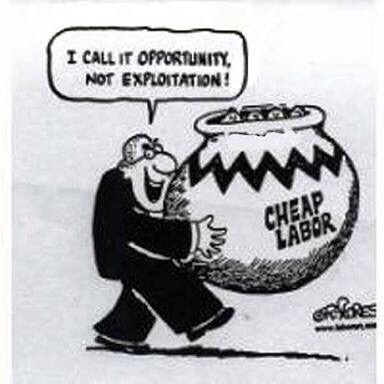
Worker exploitation ….. surprised?

  
Picture courtesy of Portside.org
The Senate inquiry into exploitation of workers has concluded its investigation and published its report titled

“A National Disgrace: The Exploitation of the Temporary Work Visa Holders”.
Reading about the report has filled me with horror at some of the practices deployed by Australian employers. The report has identified two suspect groups namely labour hire contractors and franchises particularly 7-Eleven. 
An example of the exploitative practices is a survey of 200 international students, that found 25 per cent were receiving $10 or less an hour and 60 percent were earning less than the national minimum wage.
One worker spoke about his 60 – 70 hour working week, dangerous conditions, gross underpayment of wages and overcrowded accommodation. Employers crammed 6 men into one bedroom and others into a shipping container. They then deducted $250 each week for accommodation costs. 
This worker was the victim of a labour hire company exploiting workers on a 457 visa (business sponsorship). He then said that when they were no longer required they were dismissed and pushed out of their accommodation (with police help) without receiving any notice. 
A typical 417 visa scam (working holiday visa) involved workers at a meat processing plant who did a six week training course without pay. Once training was complete they worked up to 18 hours a day, six days a week. They were frequently denied breaks and often forced to work despite sustaining workplace injuries. 
I can’t believe this is happening in Australia. For what?
Does 7-Eleven pass on cheaper products to consumers? I don’t think so. It suggests that this exploitation is directed at improving corporate profits.  I’m not saying that there can be any excuse or justification for such practices. 
There are 1.3 million foreign workers in Australia, that’ s ten percent of our workforce. 
Australians would condemn slavery. But we effectively have slavery occurring under our noses. We benefit every time we walk into a 7- Eleven store or buy processed meat? 
What consequences will these corporate fat cats suffer? Probably none. Those caught mistreating animals feel the brunt of the law. Those mistreating foreign workers will face increased regulation. 
Go figure. 
Why does corporate Australia believe it is okay to exploit people in this manner? Should we be surprised when our Federal government and opposition display a similar disregard for human rights and common decency towards refugees?

The Last Supper

  
Picture courtesy of theinformistnews.wordpress.com
The Last Supper
The story of the Last Supper, which is remembered the Thursday preceding Good Friday, has always resonated with me. 
It is a story about a group of friends dining together in keeping with the Jewish Passover tradition.  
It reminds us that Christianity and Judaism are inextricably connected. In fact, the three major religions Judaism, Christianity and Islam all have Abrahamic traditions. One would not know they shared a common history, given their attitude to one another today. Aren’t humans short-sighted, particularly when their perspective is distorted by religion?
The Last Supper has dramatic undertones as friends gather for the final time with their leader on the eve of his death.
I think it is one of the rare times in the New Testament that we see Jesus and his band of disciples together and interacting with one another. And what do we see? We see dysfunctionality and disharmony. It is a quintessentially human scene. 
We tend to idealise the Last Supper scene but when you examine it more closely, nothing could be further from the truth. For example, we find out early in the dinner that there is a traitor in their midst. Who? “Surely not I Lord,” each of them says. 
The traitor is Judas Iscariot. Many commentators have speculated on the cause of his disillusionism. Some say he was disappointed by Jesus’s passivity. Judas was expecting Jesus to use his undoubted power to defeat their Roman overlords. He was the long awaited Messiah after all! But this was not Jesus’s agenda. The Roman Empire would eventually collapse (but not before embracing Christianity in and around 320). History is rich with irony. 
Some think that Judas wanted to create an incident that would force Jesus to demonstrate his power, to create a crisis or confrontation that would force Jesus to act.
Ultimately, Judas is seen as a tragic character who is so overwrought by his treachery that he takes his own life. Judas is a broken man. 
So the dinner proceeds under a veil of intrigue. 
Another example of dysfunctionality. We know that after dinner Jesus seeks solace in the Garden of Gethsemane. He takes his friends with him ……. but they cannot stay awake. Jesus implores them to pray with him, to support him. But they cannot do it. Perhaps too much drink at dinner? We cannot help but see the weakness of the apostles …..and probably the weakness within ourselves. How many times have we said that it’s too hard or that it can wait until tomorrow or that someone else will take care of it or that I’m too tired. 
These are the people with whom Jesus chose to share his Ministry. 
Another example of dysfunctionality is the scene where Peter refuses to have his feet washed. He doesn’t get it. More on feet washing later. But Peter’s slowness is encouraging for the rest of us. Jesus chose Peter to lead his followers after he had left them. Would you hire Peter as your next CEO?
This was the same guy, who when confronted, denied knowing Jesus. “But I am sure I saw you with him,” they said. “Not me” said Peter. “You must be mistaken”. He denied knowing Jesus, not once but three times. 
Hours earlier Peter was declaring his devotion and pledging to lay down his life for Jesus. So fickle so human. 
At least Peter stuck around. The others fled for their lives once they saw their leader, helpless in the arms of the Roman constabulary. 
Remember these people were handpicked by Jesus. 
It is telling that Jesus has chosen “ordinary Joes” to carry his message and continue his mission. Jesus is interested in our weaknesses and failings. Judas is a traitor, Peter is slow and impetuous and the others are frightened, lazy, doubting and lacking in resolve. Jesus chose these people to share his final meal. 
He has come for the poor, the imprisoned, the homeless, the vulnerable, the dispossessed, the oppressed and the needy……not only in fact, but in spirit. It is telling that this message has been passed down to us through the centuries. Human history is written by the victors and it is a story of triumph and victory. The Jesus story stands in stark contrast to the rest of history. 
The Last Supper is filled with themes and messages. Always remember that throughout this time, Jesus is feeling intense pain. He is about to die. He is a prisoner on death row. He will be tortured. His death will be slow and excruciatingly difficult as he suffocates under the weight of his own body. He was scared. 
I am also taken with what they eat – bread and wine. Bread is the staple of human civilisation. It takes us back to the very first river civilisations of Mesopotamia and Egypt. The rivers provided fertile soils and soils allowed the cultivation of wheat and other grains. Importantly, these grains could be stored and consumed in lean times. 
Wine came much later. Wine has brought joy, mirth and good times since its inception. It has been the party drink of choice for thousands of years. The Ancient Greeks dedicated one of their gods to the drink. 
The presence of wine tells us this was to be a light hearted occasion despite the gravity of the situation. 
One thing that wine and bread have in common is the process by which they are made. Wheat is ground into powder before it is combined with other ingredients to make bread. Grapes are crushed into juice to make wine. The process is the same for us. All of us are ground and crushed in some way. Life can be harsh at times. We are the product of many influences and pressures. Some make us stronger others damage us. Jesus accepts all of us. 
The dinner has its macabre undertones. It is a drama evoking a wide range of emotions much like a Shakespearean play. Jesus tells his followers that the bread and wine they are about to consume is his body and blood. Come again?
Jesus is alluding to his imminent death. His body is soon to be broken and his blood spilled. He will die for his friends and for us. We are reminded that there is no greater sacrifice to be made than someone laying down their life for you. We ask ourselves, “”Why would you do that for me?”  
There are examples of people making the ultimate sacrifice, parents for their children, police and firemen for their communities, soldiers for their country. In every case there is a dedication, a devotion, dare I say it, a love for the beneficiary. 
The Jesus message is a message of love. It should not surprise us that it concludes with an act of love. 
But the meal is purposefully intended to be a memorial. Jesus says every time you share bread and wine with each other I want you to remember me. How great is that! Jesus as God wants us to remember him with a simple meal. 
He is not interested in parades or shows of strength or sacrifices or elaborate rituals. This is not his scene. Just break bread and drink wine in my name. 
Even if you don’t believe in the divinity of Jesus or don’t believe in God at all, you still have to think it’s pretty cool that this leader and philosopher in the moments before his death, would ask his friends to remember him with a meal. 
However, the highlight for me is what happens during the dinner. Jesus picks up a towel and basin, gets down on his haunches and washes the feet of his followers. This would not have been a straightforward act. These were grown men, in the dusty Middle East who travelled by foot on well worn sandals. Their feet would have been a real mess. 
Jesus chose to wash their feet, Not their hands or their heads. He chose to clean the dirtiest part of their bodies.  Here was a person with significant power telling us that it is not about power or strength or might. 
Ever since I was a child this scene has always moved me. 
Again, whether you believe in God or not, the idea of a leader humbling himself before his followers by washing their feet is quite profound. 
In humility there is power. Pacificism gives you strength. 
For me this is the takeaway message. 
How many leaders believe in service, in serving the people. How many believe in putting themselves last, how many believe in raising the lowly and downtrodden?
It may be an idealistic (if not unrealistic) principle on which to organise a country. But it should not be too difficult a principle to follow for the church that bears Jesus’s name. 
It is disappointing that the church that purports to represent Jesus has strayed so far from his message. Recent events have taught us that the church has been prepared to put itself first, even in circumstances when basic human decency and most moral codes would have told any Christian that this is plain wrong. 
Far from protecting the lowly and the helpless the church has hurt them, causing much heartbreak and damage to victims and their families. The vulnerable have been exploited.  
 The church has shunned humility and instead pursued policies of self preservation and perpetuation of evil. Underlying all these activities is an undercurrent of deceit and betrayal. 
The many profound messages of the Last Supper have been lost on the church. 
Shame. Shame. Shame.